
The United States and Iran have exchanged attacks in a sharp escalation that ended more than a month of relative restraint between the two countries.
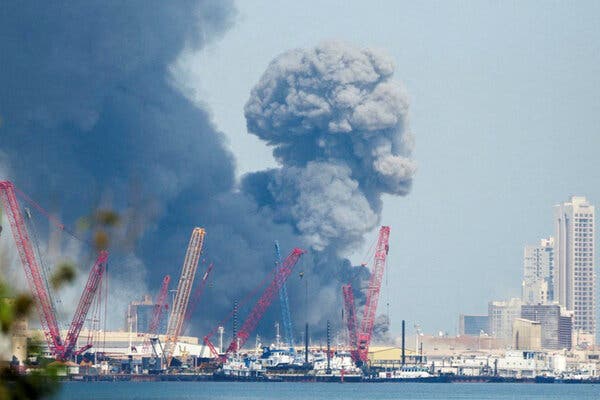
The latest confrontation began after US forces carried out strikes on two Iranian rocket launchers on Larak Island, near the strategically important Strait of Hormuz.
According to US Central Command (CENTCOM), American forces targeted the launchers after detecting Iranian personnel preparing to launch rockets equipped with sea mines into the vital waterway.
Iran subsequently retaliated, launching missiles and drones at two US military bases in Jordan, according to Iran’s Islamic Revolutionary Guard Corps (IRGC) and Iranian state broadcaster IRIB.
A US official said Iranian missiles fired toward Jordan were intercepted and that there had been no reported impacts at the time of the assessment.
The United States has not publicly confirmed the full details of the Iranian attack, while CNN reported that it had contacted CENTCOM for further information.
Iran threatens further retaliation
The IRGC had warned earlier that it would respond to the US attack on Larak Island, accusing Washington and Israel of carrying out what it called an attack against Iranian forces and civilians.
An IRGC spokesperson described the US action as a “strategic and deadly mistake” by the Trump administration.
The exchange represents the first direct US strikes against Iran since July 29, when American forces carried out what Washington described as a heavy wave of attacks following an attempted assault on US military positions.
The latest strikes raise fresh concerns that the conflict could enter another dangerous phase after weeks in which the Trump administration had focused more heavily on economic pressure against Tehran.
Strait of Hormuz remains at the centre of tensions
Larak Island lies close to the Strait of Hormuz, one of the world’s most important shipping and energy routes.
The waterway has remained a major flashpoint throughout the conflict because of concerns that Iran could use sea mines or other military measures to disrupt international shipping.
The Trump administration has said US forces recently completed operations to clear mines from international shipping routes in the strait.
President Donald Trump previously warned Iran that any vessel or boat attempting to lay new mines in the waterway would be “immediately and systematically destroyed.”
A US official said American forces were continuing to monitor the area and remained prepared to protect commercial shipping.
Diplomatic efforts under pressure
The escalation comes as Iran and Oman have been involved in discussions aimed at restoring normal maritime traffic through the Strait of Hormuz.
Regional countries, including Qatar, have supported efforts to reduce tensions. Iranian officials, however, have repeatedly linked the future of shipping through the strait to wider negotiations with Washington and developments in regional security.
The White House said Thursday that there were currently no ongoing negotiations between the United States and Iran over the six-month conflict.
Trump has increasingly emphasised economic pressure against Tehran in recent weeks, arguing that America’s financial strength could force Iran toward what he described as a major victory for the United States.
The US Treasury Department has also threatened tougher sanctions against countries that continue economic ties with Iran, particularly those involved in Iranian oil.
Oil prices rise
Financial markets reacted quickly to news of the renewed military confrontation.
Brent crude, the international oil benchmark, rose 2.8% to $90.57 a barrel, while US crude increased 2.7% to $85.64.
The rise reflects concerns that continued fighting around the Strait of Hormuz could disrupt one of the world’s most important energy corridors.
With the United States and Iran now exchanging attacks again, fears are growing that the latest confrontation could undermine diplomatic efforts and trigger a wider regional escalation.
Official accounts:
• US Central Command (CENTCOM): @CENTCOM
• The White House: @WhiteHouse
• US Department of Defense: @DeptofDefense
• Iranian state broadcaster IRIB: @iribnews
• Iranian Foreign Ministry: @IRIMFA_EN
This report is based on information attributed to US officials, US Central Command, the IRGC, Iranian state media and other reporting cited in the original account. Claims from either side have not necessarily been independently verified.